I’ve had this question in my brain for many, many years and need to get it all out. Spoiler up front: I don’t know the answer to this question, but I am curious not only about the answer but how the answer could even be found.
The short version
What is the minimum set of properties that all fair dice share?
The (much) longer version
It’s a simple question but requires a lot of clarification about what I’m actually getting at here.
Classical dice shapes
Most dice we encounter are platonic solids: tetrahedrons (4 sides), cubes (6 sides), octahedrons (8 sides), dodecahedrons (12 sides), and icosahedrons (20 sides). It’s easy to intuitively understand why these shapes lead to fair dice (and by “fair” I mean there is an equal chance of it landing on any of its faces). Every face is an identical shape to every other, every edge is the same length and forms the same angle with its neighboring faces, and every vertex has the same number of adjoining faces and angles. Assuming it has no markings, we cannot distinguish one face from another.
And some derivatives of the platonic solids can also form fair dice, such as by “tenting” each square face of a cube up into a shallow 4-sided pyramid, thus making a (6 × 4 =) 24-sided die. As long as each face is the same size and shape as every other one, it will be fair. Between the platonics and its derivatives, you can cover a lot of different numbers of sides: 4, 6, 8, 12, 24, 48, 60, all the way up to 120.
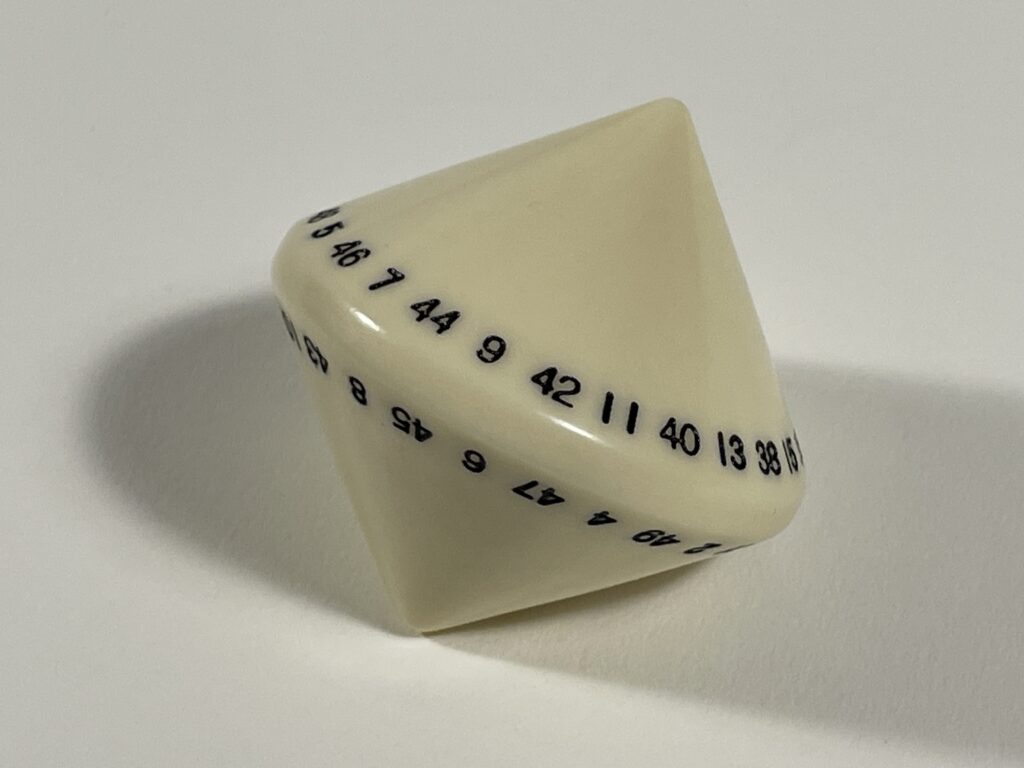
And then there are bipyramids. Imagine two 7-sided pyramids (sort of conic looking) with their heptagonal bases glued flat together, and you’d have a fair 14-sided die. You can use that trick to create a fair die for any even number of sides of 6 or more.
In all of these cases, it’s easy to convince ourselves that these would create fair dice. Every face is the same size and shape with no way to distinguish it from any other, so there’s no reason physics should favor one face over another. The only cause for bias would be defects in the materials or manufacturing, which we aren’t interested in for this discussion. We’re interested in the ideal shape that a physical die is aspiring to be.
A hypothetical D7
Suppose you took a block of perfectly uniform material and, using an amazing nanotechnology knife, cut 7 perfectly straight slices to form a heptahedron (7-sided doohickey). You’re just eyeballing the angles but trying your best to make them evenly spaced and the faces roughly equivalent in size, but we’re just approximating for now. But assume each cut forms a perfectly flat face with perfectly sharp edges and corners. You wind up with a sort of paper hat lookin’ thing. Here’s something I hacked out in Blender.
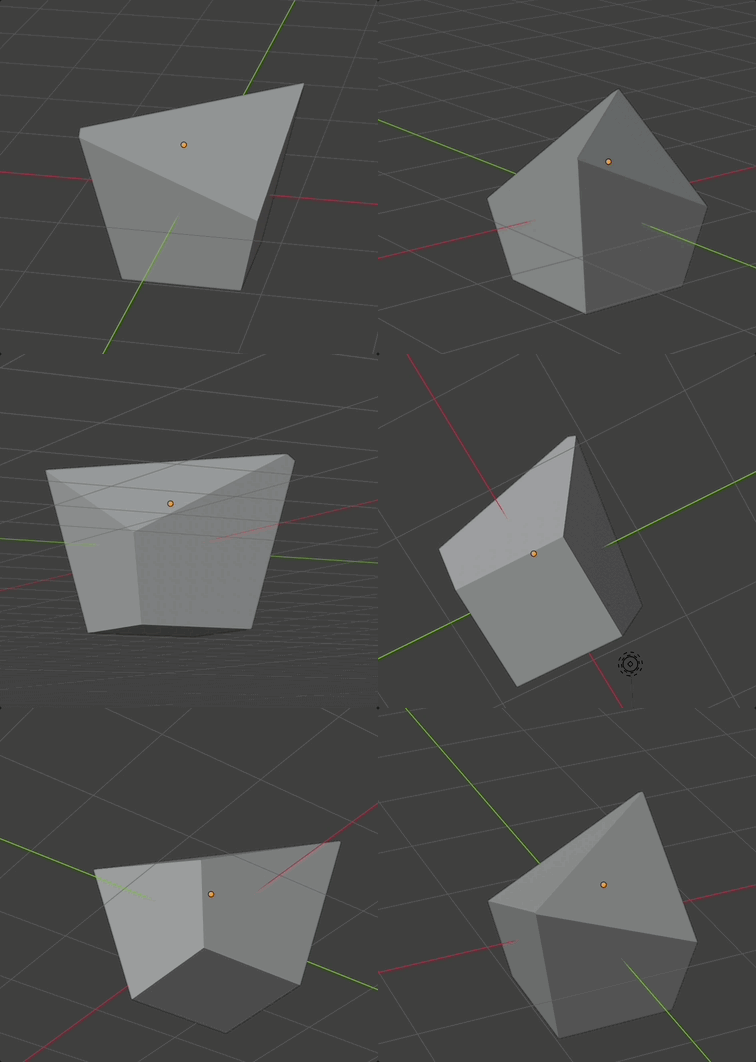
Now imagine we roll this die a bunch of times. An infinite number of times in fact, and we get perfect statistics for how fair it is. Because the higher your N the more confidence your stats have, and we’re going for infinity here: perfect confidence. It probably starts out very imbalanced, but we use those statistics to inform some adjustments, carving a little bit off our shape to even it out. Again, perfect cuts, still the same number of sides afterwards. Then we roll it again, infinity many times. Again, calculate our bias, and again, whittle away the imbalance from the shape. And we keep repeating this, making smaller and smaller adjustments each iteration, until eventually the bias is so small that any further adjustments would require splitting individual atoms. We have as perfect a D7 as could possibly exist in the physical world.
The question is…
With our new D7 in mind, here, at long last, is the question:
What properties does this strange but fair die have, geometrically, mathematically, and/or physically, that makes it fair?
Assume we can measure our die to perfect precision and can exactly describe its shape in mathematical language.
Many of the things we would point to with a fair platonic solid do not hold here. The faces are not identical. They don’t even have the same number of edges. So what can we say with confidence about this shape? And the larger question is, what can we say with confidence about the shape of any fair die?
Well, almost any fair die. Let’s set a few limits on the kinds of dice we’re discussing here, otherwise there are just too many variables.
- The shape is a convex polyhedron. No voids, no holes, no dents.
- Every face is a plane. Curves are too complicated!
- Every edge and vertex is perfectly sharp.
- Every face is valid to land on. There aren’t any “extraneous” faces that “don’t count” if landed on.
The question isn’t…
A lot of folks will jump to the related but different question of how can you design a fair die with N sides. But that’s not this exercise. Yes, you can use tricks like the bipyramid or derivative platonic solids to make dice with a lot of different numbers of sides. Maybe there are other tricks for making arbitrary odd numbers of sides too. But this isn’t a design question, it’s an analysis question.
We’re also not talking about how to make an unfair die fair, or methods to roll a conventional die to get an unconventional number of values (e.g. to get a value 1-7, roll a D8 and reroll if you ever land on 8).
Also, don’t get too hung up on my example of 7 sides. We’re not trying to solve for 7 specifically. That’s just a weird number of sides small enough to imagine. You could use 13 or 59, or even common numbers like 6 but where the shape isn’t a cube.
This also isn’t a statistics or empiricism question. Yes, you could determine if a die is fair by rolling it a bunch of times to get 95% certainty, 99% certainty, even 99.999% certainty. We’re more interested in the analytical approach. We could know a cube makes a fair die without ever rolling one, and there’s no confidence score on that assertion. It’s simply true because of its geometric properties. If a real-world cube doesn’t roll fairly it’s because it’s not quite a cube, or it was rolled on an imperfect table, or we rolled it in a biased way, or our sample size is too small. It’s not because our analysis of cubes was wrong and mathematics is now upended. We want that same certainty with other shapes that are nothing like cubes.
The goal is to get at the core properties of what makes an arbitrary polyhedron fair.
Some possibilities
The first possible property that comes to my mind is that every side has the same area. This seems plausible. And I would say even if this property does not always hold, it’s got to be close, right? If one face is substantially smaller than the others, there’s no way it’s landing on it with the same frequency as the others. And conversely if one face is really big (like the bottom of a shallow pyramid), that’s definitely going to dominate.
My second idea is a variant of that: instead of equal area, each face has equal radial area. This one is maybe difficult to explain, but it’s inspired by thinking of the die enclosed in a sphere. If you roll the sphere it will eventually come to rest with a single point in contact with the table. If you trace from that point up toward the center of the sphere, you will hit one of the sides of the inscribed die. If you put a different colored dot on the surface of that sphere corresponding to which side of the inner die it intersects with, you’d wind up with the entire sphere divided up into different colored areas. For a platonic die, those areas on the sphere would all be equally sized (in square radians, or however you measure angular area). Would that also be true for a fair D7?
What I’m not sure of is if surface area and angular area are always proportional. Perhaps if a shape has faces that are at severe angles these two values would diverge significantly, the way sitting in the front row at a movie theater distorts the screen. That’s a geometry question I don’t quite know how to answer.
Let’s set geometry aside and think about physics. An icosahedron rolls more easily than a tetrahedron. The angles between faces on an icosahedron are shallow, and it takes little energy for it to go from resting on one side to resting on a neighboring side. Whereas the tetrahedron barely rolls at all. Whatever face it lands on initially is pretty much where it’s going to stay, short of big bounces. Could a die have a mix of shallow and steep edge angles that affect rolling physics so that certain sides are less likely to be landed on despite being the same size as the others?
The physics questions make me more uneasy. It’s easy to go down a slippery slope of more and more real-world factors like friction and air resistance and elastic deformation, and that feels like it’s going too far astray from analysis. You’re no longer identifying properties of a fair die and just testing whether this particular shape is fair through simulation or empiricism. And going back to the platonic solids, we aren’t thinking of any of those factors when deciding that they roll fairly.
How do we find out?
The tricky bit for me is I don’t even know how one would go about determining an answer to this. Or who. Would it be a mathematician creating a hundred page proof? Or would it be a physicist using laws of motion governing rolling physics? Is this problem even solvable?
Maybe modeling lots of irregular shapes and rolling them in a computer simulation zillions of times would give some leads for which relationships seem strongest (not as a proof but as exploration).
I don’t know the answer to this question, but I would love someone smarter than me to pursue this, because I can’t stop thinking about it!
Examples
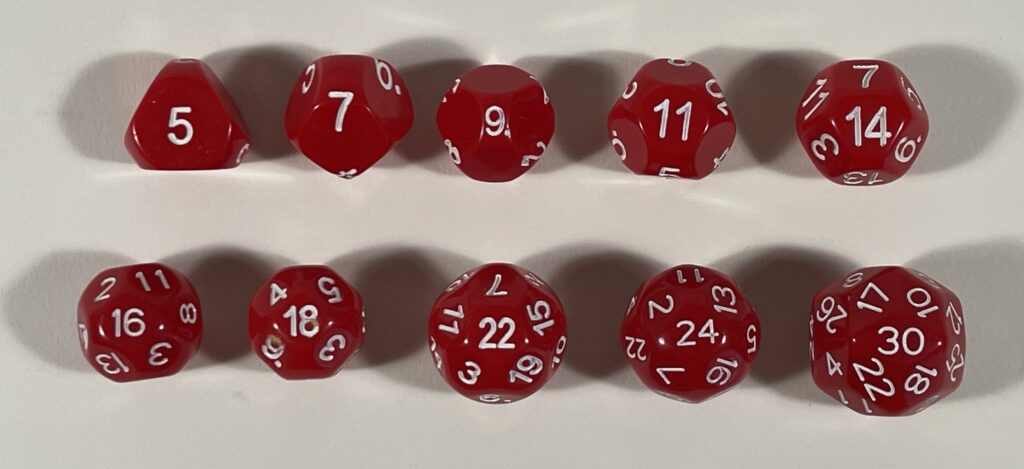
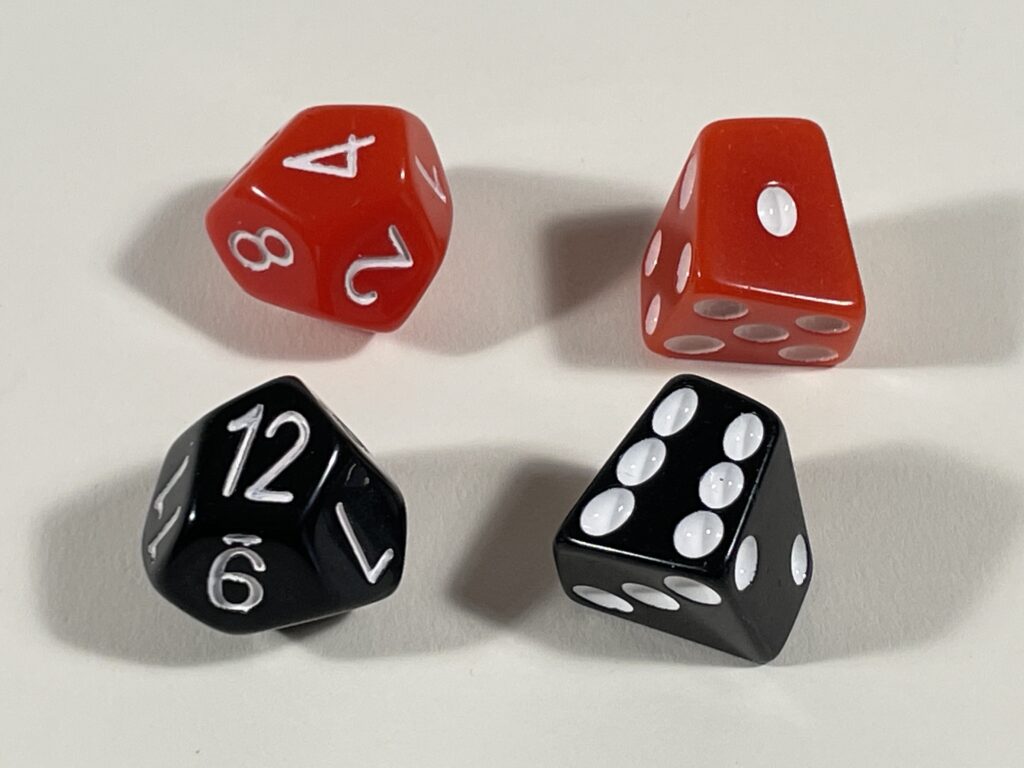
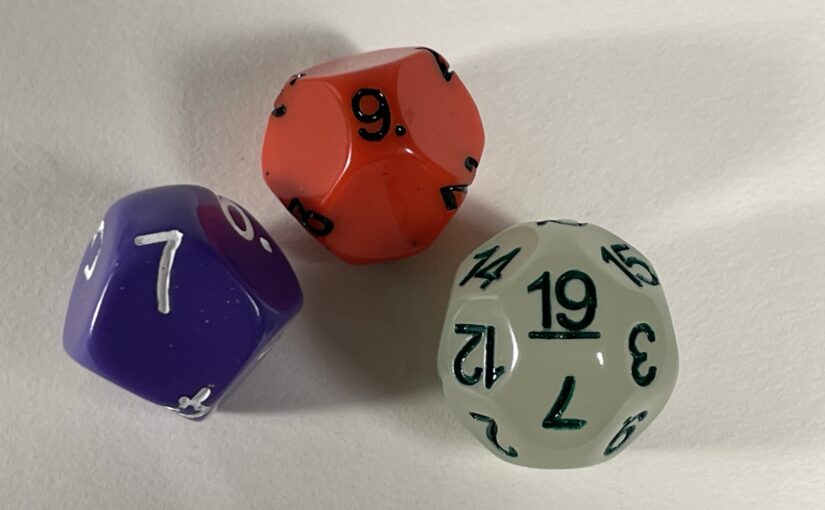
I’ll end with a few test cases to consider when you ponder your own answer. These are some dice from my collection. They’re very imperfect, all have highly rounded edges, made of cheap plastic, etc. They are surely not perfectly fair, but they’re not wildly unfair either.